Small-Bay Industrial vs. Big-Box Warehouses: What Investors Should Know
When comparing small-bay industrial vs. big-box warehouse properties, the central question is not which asset type is universally better. It is which property is designed for the tenants, business activities, and operating model of its specific market.
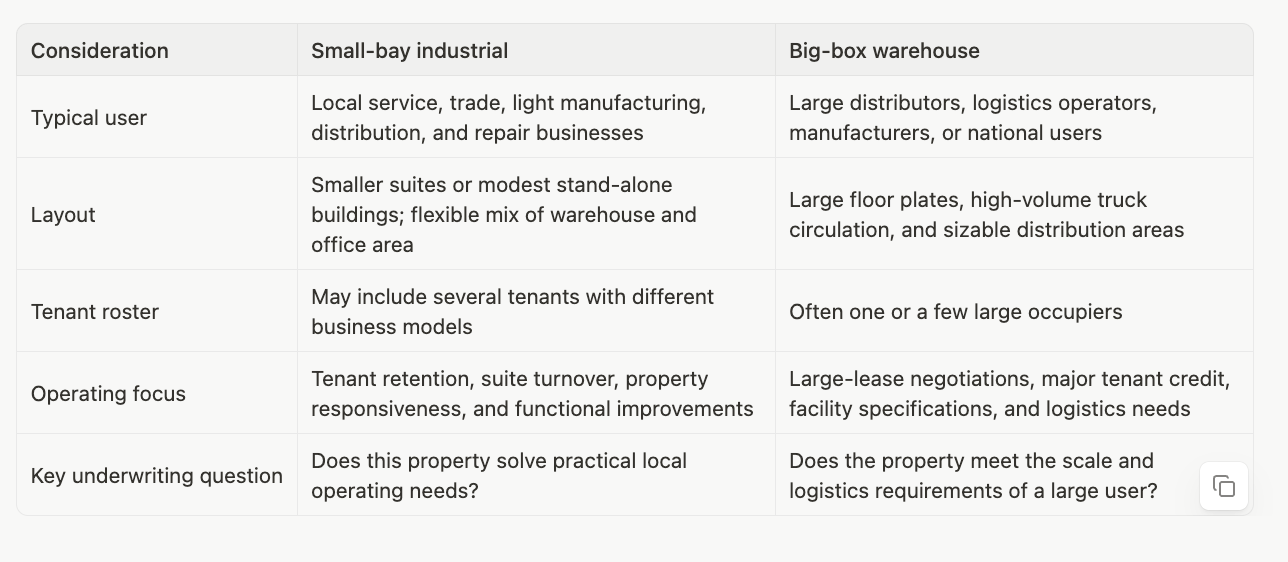
Big-box warehouses are often built for large-scale distribution, major logistics users, and high-throughput supply chains. Small-bay industrial properties are generally configured around smaller, more flexible spaces that support local businesses: contractors, service companies, specialty distributors, light manufacturers, repair operators, and other hands-on users. Both can be valuable. They solve different real-estate problems.
For investors, that distinction shapes everything from the lease structure and tenant mix to the asset-management plan and capital needs. The Oak and Clay Group focuses on value-add small-bay industrial opportunities because these properties can serve the operating needs of businesses that keep local economies moving.
The defining difference: who uses the space?
A large distribution building may be designed for one major occupier or a limited number of large users. Its value often depends on broad logistics networks, regional infrastructure, truck movement, and the requirements of a sophisticated distribution operation.
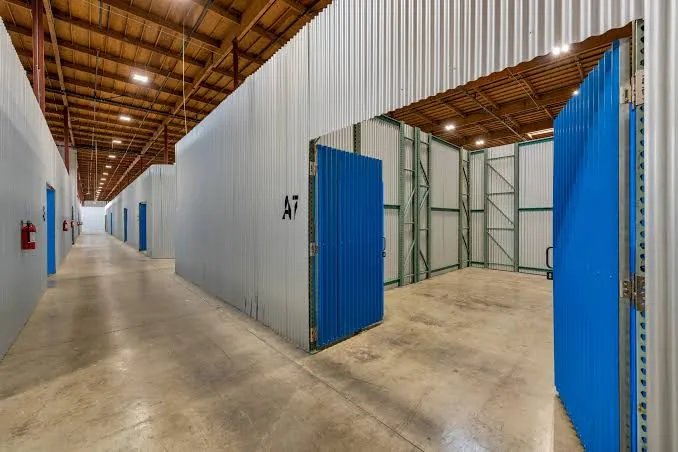
A small-bay industrial property is more likely to serve a diverse set of local or regional users. Current commercial-real-estate commentary describes small-bay assets as stand-alone buildings or multi-tenant suites below 100,000 square feet, often offering dock- or grade-level loading for local and regional business activity. A contractor may use the space to store materials and dispatch crews. A specialty supplier may combine inventory storage with a customer-facing office. A light manufacturer may need an efficient blend of workspace, loading, and modest administrative space.
The tenant’s business model should drive the real-estate analysis. A building that works well for a local trades business may be a poor fit for a major e-commerce distribution tenant, and the reverse can also be true.
Why property functionality matters so much in small-bay industrial
In small-bay industrial, the physical details often determine whether a tenant can operate efficiently. That is why investors should look beyond square footage and headline rents.
A useful small-bay warehouse may offer grade-level doors, dock positions, outdoor circulation, adequate parking, clear access, secure storage potential, and a layout that does not force a small business to pay for more space than it can use. These features are not interchangeable. The right mix depends on who actually needs the building.
For example, a repair company may care about easy vehicle access and bay-door dimensions. A specialty distributor may prioritize loading, storage efficiency, and route access. A service business may need a small office component paired with equipment storage. An investor who understands the intended tenant profile can better evaluate whether a capital-improvement plan is likely to make the building more competitive.
Multi-tenant industrial requires a different operating mindset
One key difference in the small-bay industrial vs. big-box warehouse comparison is the level of asset-management activity. A multi-tenant industrial property can distribute rent across several businesses rather than relying on one tenant. That can reduce concentration in a single lease, but it does not eliminate risk. It introduces additional leasing, maintenance, renewal, and tenant-service responsibilities.
The work is operational. Owners and managers must understand expiring leases, local asking rents, operating-cost recoveries, capital needs, and the experience tenants have at the property. A poorly managed building can lose competitiveness even in a strong location. A well-run property can become a place where businesses want to stay because it is reliable, practical, and responsive.
This is why value-add industrial real estate should not be reduced to a purchase-price discussion. A credible value-add plan identifies a specific property problem—deferred maintenance, outdated suite configuration, vacancy, poor tenant communication, weak leasing execution, or another operational constraint—and then proposes a realistic solution.
Small-bay industrial is not a shortcut to returns
It is important to separate an attractive asset narrative from a complete investment thesis. Small-bay industrial can face vacancy, tenant-default, capital-expenditure, financing, market, regulatory, and execution risks. A local business base may be durable, but it can still change. A functional property may still require upgrades. A multi-tenant rent roll may provide diversification, but it also requires active management.
The right question is not whether small-bay industrial is “safer” than big-box warehouse space. The right question is whether a specific asset has a clear purpose, a sound underwriting case, an achievable operating plan, and a risk profile that the investor understands.
Explore The Oak and Clay Group’s approach
The Oak and Clay Group provides accredited investors access to value-add small-bay industrial real-estate syndications across the Rust Belt and surrounding growth markets. Its approach begins with disciplined underwriting, transparent communication, and attention to the property-level details that make industrial space useful to the businesses it serves.
To explore the strategy in more depth, access the Accredited Investors’ Complete Guide to Passive Small-Bay Industrial Real Estate Investing. The guide is educational and is not an offer to sell securities.
Frequently asked questions
Is small-bay industrial the same as flex space?The terms can overlap, but they are not identical. Small-bay industrial commonly refers to smaller, functional industrial suites or buildings. Flex space can include a wider range of office-and-industrial configurations. The actual building layout and local market determine how a property is best described.
Why might a small-bay industrial building have several tenants?Smaller suites can match the space needs of local businesses that do not require a full distribution center. Multiple suites may also spread income across tenants, although they create additional leasing and management work.
What should investors compare besides building size?Focus on the tenant base, loading and access, suite configuration, lease terms, operating expenses, condition, required capital, management plan, and local competitive supply.